
Your team might be on the way to adopt Agile to boost productivity and to better respond to changes in business environment. Meanwhile, transitioning to any new methodology can be challenging for most organization, especially when it involves changes in mindset. Sometimes there can be mental barriers within the team, preventing them from taking actions.
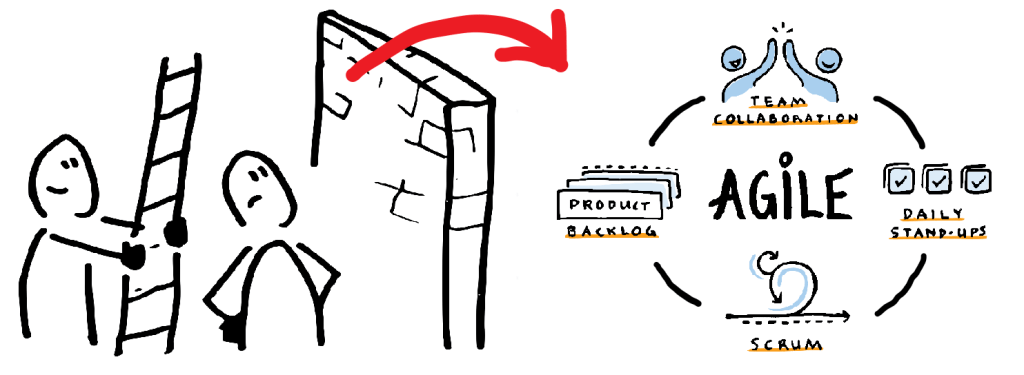
Over the years, I have heard justification why some teams can’t adopt Agile, despite they can really benefit from this methodology. Here are few things I have heard:
— — “We have too much work to do right now. We can’t stop the work to implement Agile.”
— “We don’t have the budget to hire an Agile coach to set up the framework and re-structure the team. Before that, we just continue what we have.”
— “Our software has dependency on other teams, especially the hardware team. If they don’t adopt Agile, we can’t either.”
— “There’s too much overhead with Agile framework. It is waste of time to track burn-down chart and measure the velocity. The daily standup is also overkilled. “
— “Our team is mixed with seniority levels. Agile does not work for us especially the estimation part. The tasks can be assigned to different developers who may be slower than others.”
Some of the statements might reflect good reasons, but some might be due to misconception, habitual or cultural issues. If not addressed, these mindsets can become the barrier of your agile adoption, or simply reduce the efficiency regardless what your current methodology is . In order to overcome the barriers, here I recommend few things you can do to break the status quo.
- Clarify the misconception
If people are unclear why a particular Agile practice is necessary, it leads to resistance, mistrust and inefficiency. Let’s take “agile estimation” as an example. Because developers don’t like to be imprecise, it is not unusual that they are reluctant to give estimates, especially if they assume the estimates should be in hour or days. We need to explain the purpose is not a blood-oath commitment, but a “team sport” to align their perspectives regarding the “effort” or “complexity”. Through the process, the team with mixed seniority can also benefit from knowledge sharing and open communications. The practice is also an opportunity to ask for clarification if a user story is not properly groomed.
When any misconception is clarified, and people understand the purpose and benefits of each practice, it will be the first step for engagement. - Don’t wait. You can start applying Agile principles to improve productivity now.
Although it’ll take a while to prepare the organization to fully adopt agile framework, it does not mean you can’t start taking action. You can identify the critical gap and start applying some Agile principles without calling it. Say, if your team is often distracted by new requests, borrow the principle of sprint planning to re-align the objective and priority towards your next milestone. If the cooperation in the team isn’t smooth, call a retrospective meeting to discuss what we did well, what did not go well and what can be improved. If there are inter-dependency with other teams, lets re-align business context, roadmap and break-down user stories & tasks, then communicate or negotiate the order of execution with other teams.
There are plenty of tools you can get inspired from Agile to improve productivity, even before you declare full-speed Agile adoption. - Cultivate the agile mindset and embed the spirit into daily work
There is no guarantee for success even if your team knows all about SAFe framework and the fancy terminologies, because we’re also dealing with cultural shift to be self-organized, to improve transparency and to encourage open communication. To cultivate such agile mindset, it is not enough to print out beautiful posts to remind people about the value. We need to embed the spirit into people’s daily interactions and make it “relevant”.
Let’s take the “stand-up meeting” as an example. If the team is lacking the dynamics, or there are people working remotely, the daily stand-up is a short, daily meeting to come forward discussing progress and identify blockers. In my opinion, this activity provides the perfect environment to foster collaborative spirit as a team. (And yes, lots of organizations have run daily stand-up with remote teams successfully!)
Conclusion
The journey to adopt Agile will take time and there will be different challenges ahead. While some of the challenges may need top-down approach, such as re-structure the organization, many challenges are related to people’s mindset, which can be solved from the bottom-up approach. When you observe mental barriers from the team, gather their feedback and address the concerns. This will be the first step towards with smooth transition.
 Zenova Technology